
Stop Funding the AI Yield Crisis.
FIRST, Solve the $383B Alignment Gap with Strategic Maturity.
Do you know? 80% of artificial intelligence (AI) projects fail; that’s 2x the failure rate for IT projects that do not involve AI.
Most companies don’t fail at AI because the technology is bad.
They fail because they’re not ready for it.
AI doesn’t fix fragmented processes, legacy systems, or unclear strategy, it amplifies the maturity gaps that already exist.
Take the free Strategic Maturity Assessment below to see where you really are, and how to get where you need to be.
Why AI Initiatives So Often Fall Short
AI adoption isn’t winning because organizations jump into tools without the foundational readiness that drives real value.
Too many pilots never scale
Investments are made before strategy
Governance is fragmented across teams
AI is treated like a product, not a transformation
In a Forbes article, 10 AI Strategies That Fail to Deliver Business Value, the lack of business alignment is identified as a key reason many AI initiatives deliver little measurable impact and waste resources.
AI isn’t failing. People are.
Only organizations that balance purpose, execution discipline, and strategic governance will see lasting value.

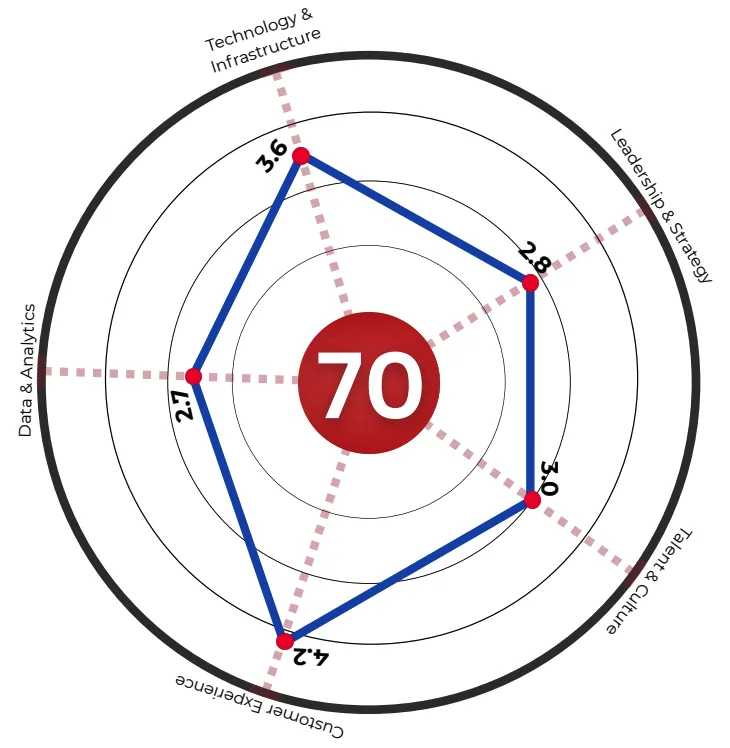
Strategic Maturity Assessment in 5 minutes
Know your AI readiness. No pitch. Just clarity.
This executive-focused assessment gives you:
Your strategic maturity stage
AI readiness across people, process, technology, and governance
A clear view of where you’re blocked, and why
Strategic recommendations tied to business outcomes
This isn’t vanity scoring, it tells you what to prioritize.
The 5-Pillar Framework for Strategic AI Sovereignty
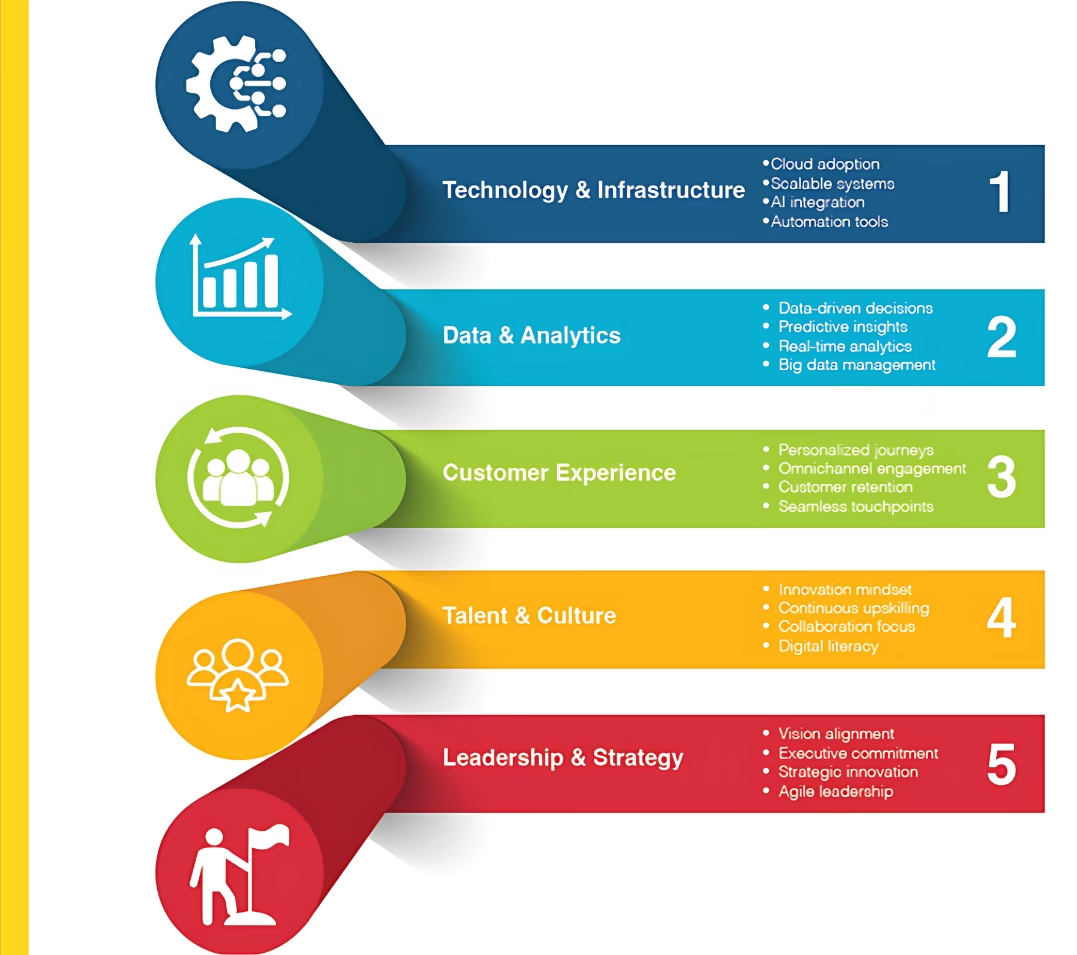
The MATURITY Code™ behind the assessment algorithm is strategically aligned with the foundational research and frameworks established by global leaders like McKinsey, Gartner, BCG, Deloitte, and MIT Sloan.
The globally accepted 5 pillars of transformation:
Technology & Infrastructure
Data & Analytics
Customer Experience
Talent & Culture
Leadership & Strategy
All top-notch frameworks have a common voice that each of these five pillars is measured on a progressive scale across five stages of strategic maturity: Awareness > Experimentation > Integration > Optimization > Transformation.
Performance Across Maturity Stages
This table illustrates how organizational performance evolves as companies progress through the five stages of strategic maturity. As maturity increases, AI adoption scales, decision-making becomes data-driven, and value shifts from isolated wins to predictable, repeatable outcomes.
| KPI | Awareness | Experimentation | Integration | Optimization | Transformation |
|---|---|---|---|---|---|
| AI Adoption at Scale | <10% | 10–20% | 20–35% | 35–60% | 60%+ |
| Clear AI Strategy | Rare | Emerging | Partial | Operational | Standard |
| Data-driven Decisions | Sporadic | Functional | Departmental | Cross-Functional | Enterprise-wide |
| AI Revenue Contribution | Minimal | Isolated | Noticeable | Significant | Core |
| Operational Efficiency Gains | Little | Early Wins | Process Improvement | Measured | Optimized |
| Customer Retention / NPS Gains | No measurable impact | Early signals | Variable | Predictable | Elevated |
| Cross-Functional Adoption | Rare | Pilots | Moderate | Broad | Pervasive |
The AI Strategy Map: From Insight to Action
Assessment results are only the starting point.
You need a strategy that sequences change, not just scores it.
The AI Strategy Map helps leaders move from insights to execution with a clear framework that:
Prioritizes what matters to your business outcomes
Aligns AI initiatives to capability maturity
Avoids costly missteps and redundant tool spend
Ensures governance + PMO coordination drives scale
This thinking reflects the core argument, in this Forbes article, The CX-AI Maturity Gap: Why Companies With Strong PMOs Are The Only Ones Scaling AI Impact, that execution discipline, not buzz, separates organizations that scale AI from those that stall.
This strategy map embeds clarity and cost-savings into your AI roadmap, helping you turn maturity into measurable ROI.
Why This Matters Now?
Organizations are moving from 'Buying AI' to 'Governing Maturity.' If you aren't the architect of your maturity, you are the victim of your technical debt.

2026: The Year of Strategic Reform
AI acceleration without maturity strategy grows gaps, not value.
Organizations that succeed:
Cut wasteful spend
Align AI with customer, employee, and operational outcomes
Sequence investments in the right order
Build governance that sustains change
If you’re not approaching AI through a strategic maturity lens, you’re likely:
Spending on tools that double work not reduce it
Stalling pilots because data or teams aren’t ready
Falling behind competitors who do have a plan
Most companies think they’re ready for AI but they’re not. The assessment reveals what they don’t see.

Who This Is Built For
This assessment and strategy are designed for leaders who own outcomes, not experiments:
CEOs & Founders
CIOs / CTOs / CDOs
CMOs, CX & Experience Leaders
Transformation / PMO Leaders
Operations & Strategy Executives
If you’re accountable for impact, not exploration, this is your starting point.

“I help leaders cut through the noise, see where they really stand, and make decisions they can stand behind.”
—Nav Thethi

About Nav Thethi
Nav Thethi is a highly respected digital economist and thought leader in digital marketing, known for a distinct focus on customer experience and digital optimization.
A Chief Maturity Architect, with a passion for crafting strategic business sovereignty for post-AI era, Nav ensures that every customer’s digital journey is relevant, reliable, and strategically aligned with overarching business objectives.
Executive digital strategist driving measurable growth through customer-centric vision
Recognized thought leader bridging CX innovation data strategy enterprise leadership
Deep enterprise experience transforming global brands with analytics and execution.
Rare blend of business economics certifications agile delivery strategic clarity
You gain practical frameworks mentorship and outcomes aligned executive priorities
What Leaders Are Saying

Donovan Neale-May
Nav is always on a “make a difference” ambition. His research work and columns have been very insightful for our audience.
— CEO, CMO Council

Olga Mack
What stands out about Nav is how naturally he connects the technical to the strategic.
— CEO, TermScout

Jeffrey Hayzlett
Nav has a strong grasp of AI transformation, and he understands how to align it with actual business priorities and measurable outcomes.
— Founder, C-suite Network

Bill Schmarzo
Nav has a rare ability to connect the dots between technology, strategy, and value creation.
— Dean of Big Data | Professor at UIowa

Tabitha Dunn
Nav has a unique gift for looking past the hype of innovation to focus on what actually moves the needle: meaningful customer outcomes.
— CCO, Former Chair CXPA

Dom Nicastro
Nav is one of our great contributing authors to CMSWire who walks the walks when it comes to digital customer experience.
— Editor in Chief, Simpler Media Group
Curious to see your 2026 Strategic Maturity Blueprint?
AI isn’t waiting, your competitors aren’t either.
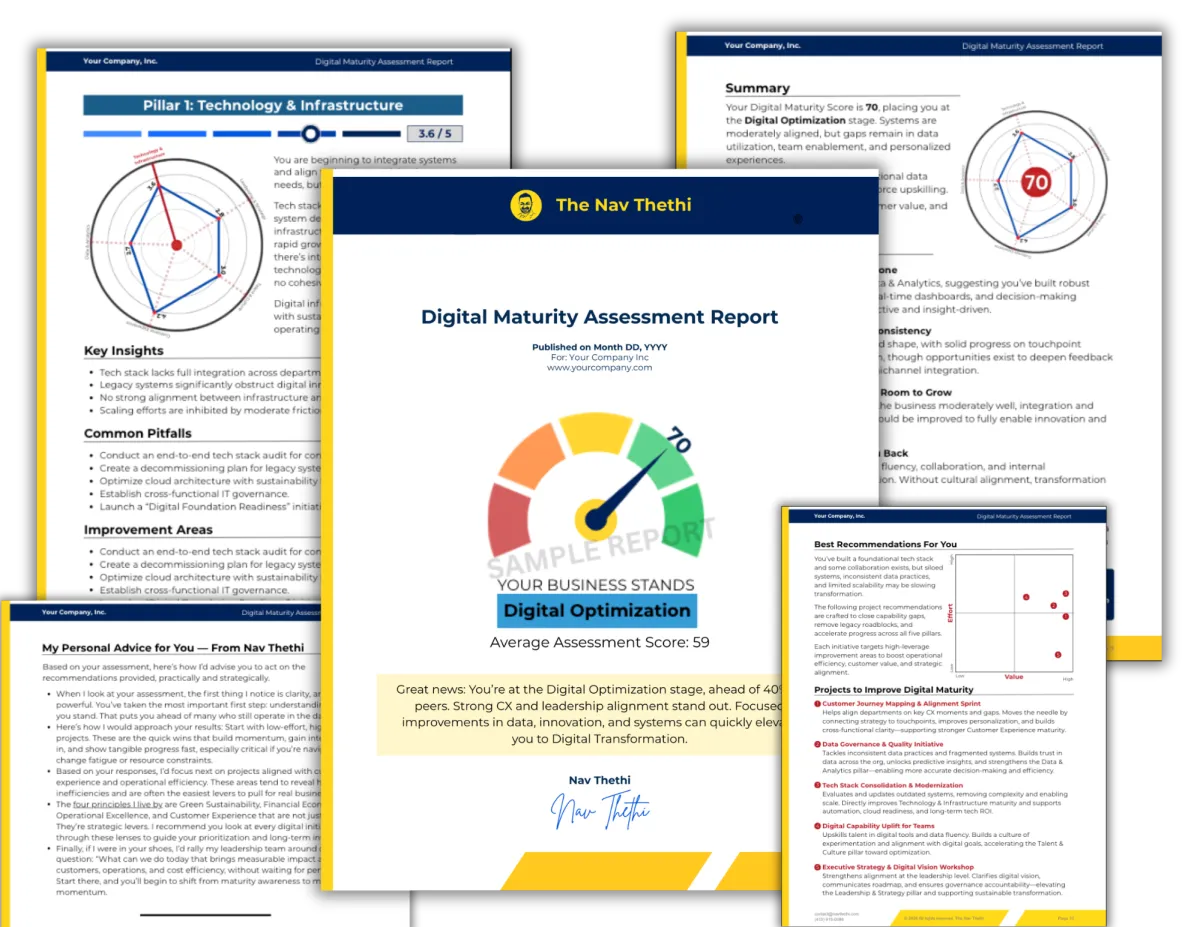
Explore a sample of the customized reporting provided to every leader who completes the assessment.
See where you really are
See what’s blocking value
See how to transform with AI the right way
FAQs
Your Questions Answered: Insights for Clarity and Confidence
Why should companies conduct a strategic maturity assessment before investing further in AI?
Companies should conduct a strategic maturity assessment before investing in AI because AI success depends on organizational readiness rather than technology availability. A Forbes article analyzing AI failure patterns highlights that most AI initiatives fail due to weak foundations across strategy, data, governance, and execution. A strategic maturity assessment identifies these gaps early, helping organizations avoid investing in AI initiatives that are unlikely to scale or deliver measurable value. AI amplifies existing maturity levels, meaning unprepared organizations often experience higher costs and operational complexity rather than transformation benefits.
How does this strategic maturity assessment help leaders after completion?
This strategic maturity assessment provides leaders with actionable insight rather than abstract scoring. The output includes identification of the organization’s strategic maturity stage, readiness insights across critical pillars, and clarity on which AI initiatives are viable, premature, or unnecessary. The assessment highlights structural and operational constraints that limit AI value creation and establishes clear priorities for near-term and long-term transformation. Leaders gain a foundation for decision-making that reduces waste and increases the likelihood of sustained AI impact.
Why is it important to conduct a strategic maturity assessment now rather than waiting for AI to stabilize?
Waiting for AI to stabilize increases long-term cost and competitive risk. AI capabilities are evolving rapidly, and organizations that delay readiness often face higher re-implementation costs, fragmented tool ecosystems, and change fatigue across teams. A Forbes perspective on AI maturity emphasizes that organizations unprepared today will struggle more tomorrow as AI becomes embedded into core operations. Conducting a strategic maturity assessment now enables deliberate preparation, smarter sequencing, and reduced risk before complexity and cost escalate further.
What do leaders say about Nav Thethi’s expertise in strategic maturity and AI transformation?
Leaders consistently describe Nav Thethi’s expertise as pragmatic, outcome-oriented, and clarity-driven. His work is recognized for challenging common assumptions about AI adoption and refocusing leadership attention on maturity, execution, and governance. Executives highlight his ability to translate complex AI concepts into strategic priorities that align teams and drive measurable results. This perspective has positioned him as a trusted voice in strategic maturity and enterprise transformation discussions.
What is the failure rate of AI initiatives, and how does strategic maturity reduce that risk?
Multiple industry studies show that more than 70 percent of AI initiatives fail to produce meaningful business impact. A Forbes article examining the strategic maturity gap explains that this failure rate is primarily driven by misalignment between AI investments and enterprise readiness. Organizations with higher strategic maturity consistently align AI initiatives to business outcomes, apply strong governance, and sequence adoption based on capability readiness. Strategic maturity reduces risk by ensuring AI initiatives are scalable, measurable, and strategically justified before significant investment occurs.
How do highly strategically mature companies approach AI differently?
Highly strategically mature companies approach AI as an enterprise capability rather than a collection of tools. A Forbes article exploring the CX–AI maturity gap explains that these organizations prioritize execution discipline, cross-functional governance, and outcome-based investment decisions. AI initiatives are aligned to customer experience, operational efficiency, and financial performance, with adoption and change management treated as critical success factors. This maturity-driven approach enables consistent scaling of AI value while less mature organizations remain stuck in pilot mode.
What differentiates Nav Thethi’s strategic maturity approach from other AI readiness frameworks?
Nav Thethi’s strategic maturity approach is grounded in execution-focused transformation rather than vendor-driven frameworks. His Forbes contributions consistently emphasize maturity, governance, and outcome alignment over technology enthusiasm. The model connects AI initiatives to measurable business impact, prioritization discipline, and organizational readiness. Leaders value this approach because it simplifies decision-making without oversimplifying the complexity of enterprise transformation, particularly in AI-driven environments.
What core principles should organizations prioritize regardless of AI or business objectives?
Strategically mature organizations consistently prioritize four core principles regardless of industry or goals. These include strategic alignment between AI initiatives and business outcomes, execution discipline through governance and prioritization, data readiness that supports decision-making, and human adoption supported by culture and change management. A strategic maturity assessment evaluates performance across these principles, ensuring organizations build AI capabilities that are scalable, sustainable, and value-driven rather than experimental or fragmented.


